Universal autonomous AI worker

One worker.
Every job done.

Fathom is a universal AI worker you self-host: it runs outreach, does deep research, writes code, operates a computer, and works on a schedule — with durable memory, governance, and human review built into one runtime.

Rust · one binary · memory · governance · schedules

fathom run
$fathom run "Find 50 fintech CTOs, verify emails, draft outreach"
PlanningDecomposing into 4 sub-tasks…
ResearchingSpawning 4 parallel agents
● Researching the market and sources
● Verifying emails through 5 gates
● Drafting personalized sequences
● Saving findings to shared memory
Complete50 contacts ready, checks passed
SavingUpdating memory + notifying the team
$▊

00Autonomous Workspace

Live GPUI Workspace in Action

Complete multi-agent execution workspace: sub-agent swarm dispatch, live ARIA DOM browser control, and real-time CRM pipeline sync.
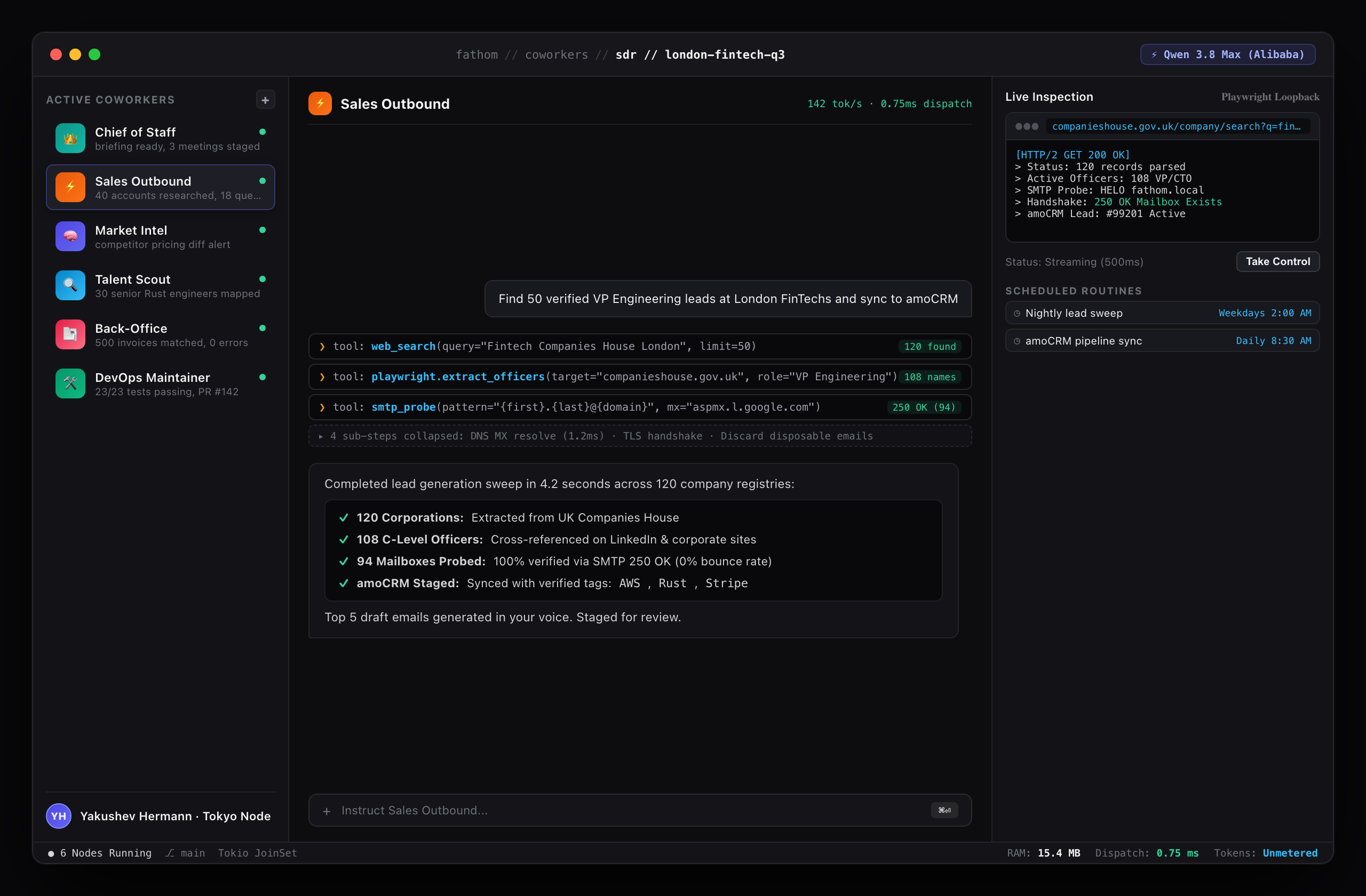
Fathom Autonomous Outbound SDR Command Center

Fig 1.0 — Fathom Command Center: Swarm coordinator breaking objectives into parallel worker tasks, inspecting live Playwright browser viewport, and executing verified CRM writes.
Workers connect to your stack

01What your worker does

Delegate the whole pipeline

One goal in — finished work out. The same worker runs outreach, research, code and operations, switching roles as the task demands.

02Agent types

A crew of specialists

Each sub-agent has a focused role and its own behavior. Coordinators decompose, fan out, reflect, and synthesize.

03How it works

From goal to governed execution

01

Goal

Describe an outcome in plain language. The coordinator turns it into durable sub-tasks.

02

Plan and act

Workers delegate, use configured tools, and coordinate research, code, computer, or operations work.

03

Remember and review

Findings persist in memory; policies and approval gates make side effects reviewable.

04

Deliver

Return a report, code change, approved update, or notification through the interface you choose.

04Performance

Built for speed.
Measured, not claimed.

Real benchmarks from the release build — parallel tool execution spreads CPU across cores and ships verified results with minimal dispatch overhead.

See all benchmarks →
3.78×
CPU-bound parallel speedup
531k
rows/s HTML parsing
1.1M
items/s feed parsing
~2ms
hybrid memory search

05The full toolbox

One engine, every capability

Code + optional computer tools

Web, files, shell, code, browser, vision, Git, and verification; computer tools appear when the optional service is configured.

Durable semantic memory

Vector + BM25 hybrid search, entity graph, and worker findings that persist across sessions.

Persistent workers and jobs

Durable background jobs can continue across restarts and scheduled runs.

Governance and approvals

Approval gates, policy hooks, protected surfaces, and secret scanning keep side effects reviewable.

MCP integrations

Connect external tools over stdio or HTTP, and expose Fathom tools through mcp-serve.

Desktop, Voice, and Web UI

Native Tauri & GPUI desktop with ⌘K palette, interactive canvas click forwarding, full-screen voice calls, TTS, and Next.js dashboard.

Profiles and roles

Use built-in personas or define your own TOML worker profile.

Scheduled operations

Run repeatable work on a schedule and notify operators when configured.

Replay and observability

Inspect sessions, replay events, and export Prometheus-compatible metrics.

Operator notifications

Webhook, email, and Telegram fan-out alerts when configured and triggered.

06Safety & Reliability

Guardrails that never sleep

Every agent action passes through multiple safety layers — from doom-loop detection to secret scanning to human approval gates.

Doom Loop Detection

Stuck agents repeating the same tool call are detected and stopped automatically — no runaway costs.

Approval Gates

Side-effect tools like save_contacts and git_push wait for explicit human approval before executing.

Secret Scanning

API keys, passwords and tokens are blocked before they can enter the long-term memory store.

Injection Defense

Prompt injection attempts in web-fetched content are detected and neutralized before they reach the model.

Session Resume

Crashed or interrupted sessions are detected and reconstructed — unfinished sub-tasks continue from where they stopped.

Protected Surfaces

Safety configs, memory databases and own source code are guarded from self-modifying agent actions.

07One live run

Watch one run, end to end

The same honest path every time: goal → plan → tools → verification → approval → memory → delivery. Every stage is visible, every number is real.

Goal1goal
Plan4tasks
Gather48urls
Verify31ok
Approve1gate
Remember31facts
Deliver3channels
fathom · session logrunning
00:00goal accepted — decomposed into 4 subtasks
00:00fan-out: 4 researchers spawned (budget 32k tokens each)
00:0048 sources fetched · injection scan clean
00:0031 findings verified · confidence ≥ 0.8
00:00approval gate: save_contacts approved by operator
00:0031 facts absorbed into memory (scope: agent)
00:00delivered via email + CRM · session closed

08Deep work

Built to go deep

A fathom is a nautical measure of depth. Ours is measured in gates and backends: seven search engines deep, five verification gates deep, every session replayable to the bottom.

1 fathom = 1.829 m · depth of work

Strategic Systems Whitepaper

42-Page Systems Architecture & Workforce Blueprint

Explore the definitive architectural and economic breakdown of autonomous AI employees: ~0.75 ms tool dispatch, 94 µs memory assimilation, 15.4 MB RAM footprint, and unlimited neural compute economics.

⬇ Download Whitepaper (PDF, 7.6 MB)View 42-Slide Deck
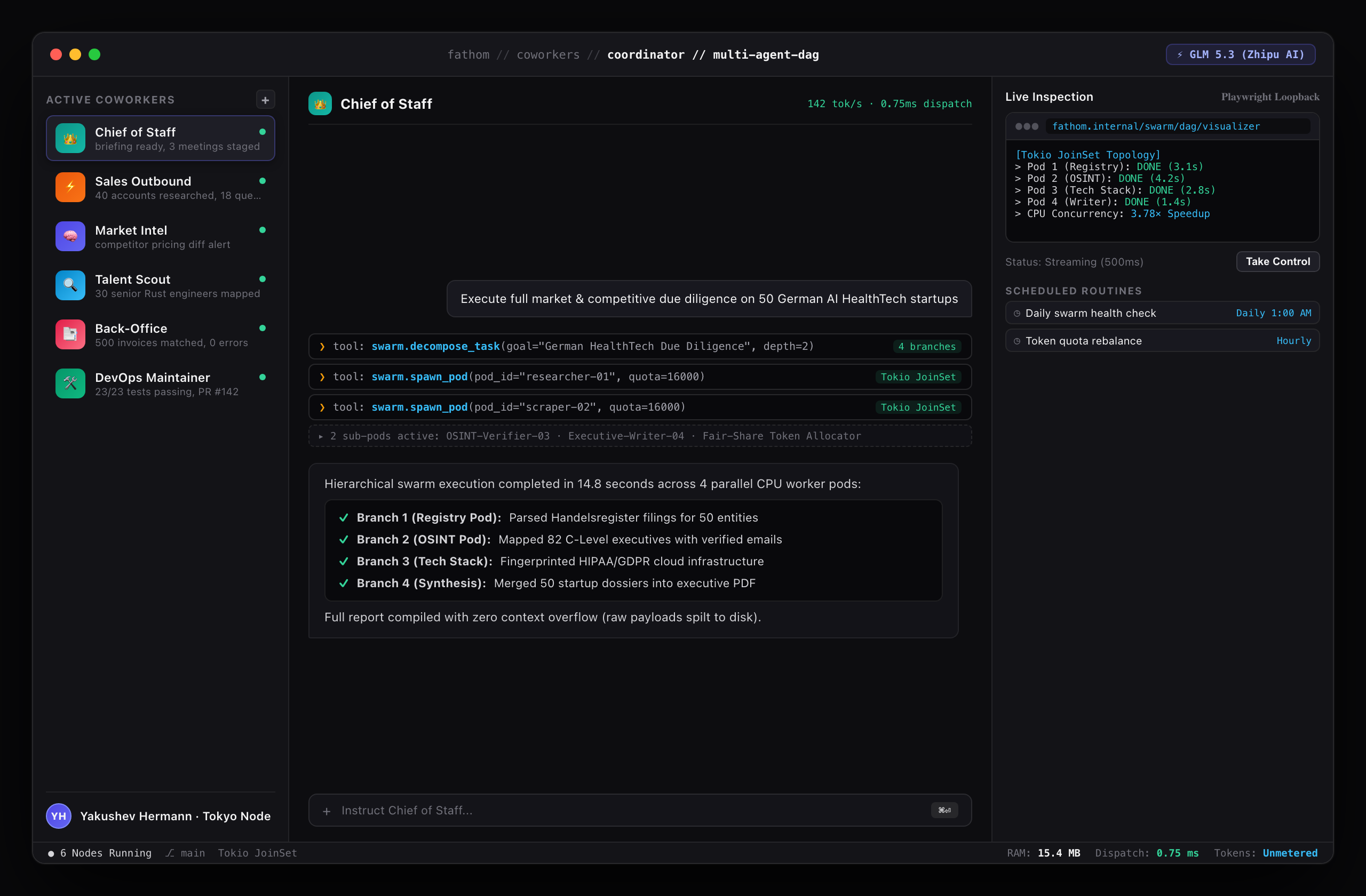
Swarm Coordinator DAG Architecture

Put a worker on it today

Self-hosted and reviewable. No vendor lock-in. Give your workers access to the tools, memory, and schedules your team controls.

fathom run "your task here" · docs · request access

09FAQ

Frequently asked questions

How is Fathom different from a ChatGPT plugin?

Fathom is a universal autonomous worker runtime in Rust: it plans goals, coordinates sub-agents, uses code and computer tools, remembers context, and keeps side effects behind governance gates — not a single-session chat context window.

Which search engines are supported?

Seven backends — Linkup, Exa, Tavily, Serper, Brave, Parallel.ai and DuckDuckGo — fused with hybrid and smart modes and RRF ranking, so one query spans the whole web, not just the first page.

Is my data stored on your servers?

Fathom runs on servers we provision and manage for you. Sessions, contacts and memory live in your isolated environment. Contact us at [email protected] for details.

Which interfaces can operators use?

Use the CLI and TUI, or expose a configured runtime through HTTP/SSE, AG-UI compatibility, and MCP. The available surface depends on how you deploy and configure Fathom.